
Built Around What Works: Calving 2026 Recap
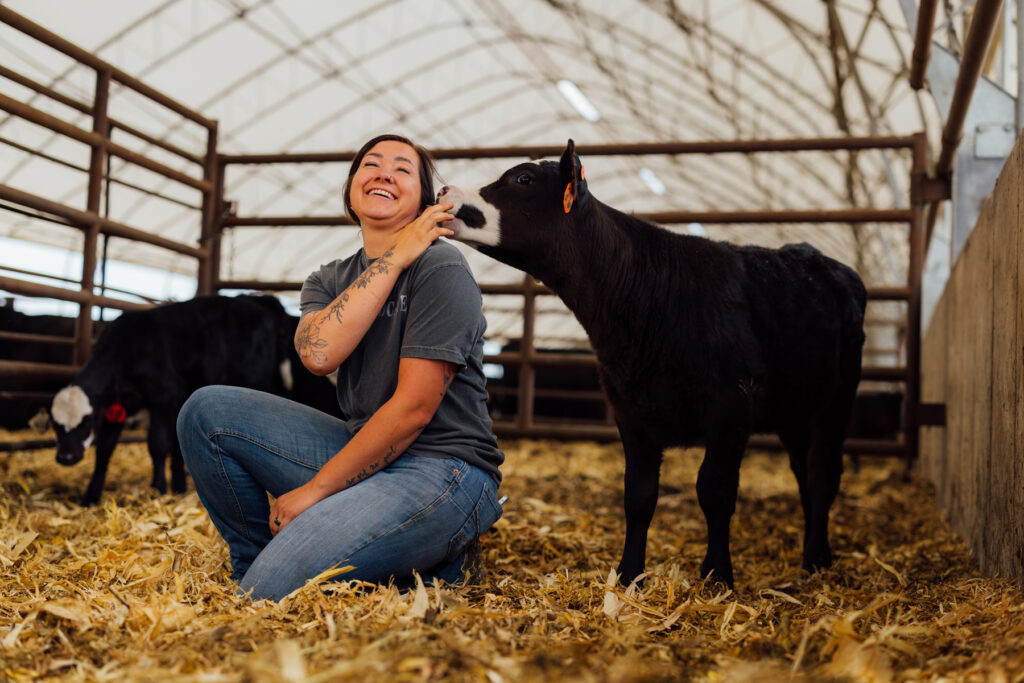
Year after year, southwest Minnesota farmer Andrea Flemming (@ThatFitAgvocate) keeps finding new ways to make the most of her Accu-Steel building. This spring, we checked in with her on how calving season went—and what she’s already planning for next time.
Table of Contents
Third year’s the charm
There’s a rhythm to farming that only comes with repetition. The first year, you survive. The second year, you adjust. By the third year, you start to own it.
That’s exactly where Andrea Flemming finds herself now on her family’s fifth-generation farm in southwest Minnesota. Multiple calving seasons into her Accu-Steel fabric-covered cattle building, this spring was about fine-tuning everything inside.
“I feel like this was the year we really locked in most of the systems,” Andrea said. “The growing pains of building a barn and going confinement—we worked through a lot of that.”
Finding the right calving barn system
For Andrea, “locking it in” means something specific. Health protocols. Vaccination timing. How often the alley gets scraped. How pairs get sorted after calving. This year, she leaned into a modified version of the Sandhills calving method—gating pens by calf age to reduce disease exposure—while dialing in the cadence of day-to-day barn management.
The results showed up in the numbers. Their calving window tightened significantly, with well over half the herd calving two weeks earlier than the prior year. Health problems were down compared to last season. And the overall pace felt more consistent—fewer dramatic swings, more steady progress.
“It just went a lot smoother,” she said. “Slowly but surely, we’re getting there.” The controlled environment the barn provides is the foundation that makes that kind of fine-tuning possible. When weather isn’t the variable it used to be, everything else becomes easier to manage.
Calving 2026 by the numbers
This season, Andrea’s operation welcomed 195 calves, which is right in the sweet spot for their current setup. After an earlier year pushing past 220 and running into bottlenecks when the feedlot filled up during spring turnout, she’s found that 190–200 is the goldilocks number that keeps everything manageable without leaving capacity on the table.
“It was a safe and healthy calving season for everyone,” she said. “Perfectly boring—and we love that.”
Three sets of twins this year. A calving window that kept tightening. And for the first time in a few seasons, no weather emergencies worth losing sleep over.
More than a calving barn
One of the things Andrea keeps coming back to is flexibility. Her Accu-Steel building was designed around calving season, but it doesn’t stop earning its keep when the last calf hits the ground.
She’s already thinking about using the space for heifer development—keeping replacement heifers in the barn rather than an outside lot—and has had conversations about backgrounding calves through the summer months to create more consistent cash flow before cows come back in for winter.
“That’s why we went with Accu-Steel,” she said. “It works for more than one thing.”
That kind of multi-season utility is exactly what Accu-Steel’s cattle buildings are designed for: purpose-built around your operation, not the other way around.
What she’d change for her next barn
Ask any producer who’s spent real time in a building what they’d do differently, and you’ll learn more than any spec sheet can tell you. Andrea doesn’t hesitate.
Here’s her current wishlist:
- A wider concrete apron along the feed alley—something she notices every time equipment has to maneuver in tight quarters.
- An alleyway down the middle of a future barn to store manure, park equipment, stash extra bedding, or hold pairs without making a dozen trips from one end to the other.
- Built-in gates and alleys that make sorting and moving cattle easier, without having to take apart panels along the way.
“When you’re making six trips down the barn carrying stuff,” she said, “fifty-four feet starts to feel a lot further than it looks.”
None of this is criticism. It’s the kind of hard-won operational knowledge that only comes from actually using a building, season after season. And for Andrea, it’s already shaping what the next barn looks like.
“Dad says it depends on the markets,” she said. “But the conversation is already happening.”
That’s the thing about a building that works: it doesn’t take long before you start thinking about the next one.
Ready to think through what your cattle facility could look like? Get in touch with the Accu-Steel team—we’ll start with your operation and work from there.